Wednesday, October 31, 2012

Nostalgia and a normative historiographical recovery in Spain today

Thinking back to the conclusion of the Spanish Civil War, the victory of Fascist Generalissimo Franco, and the rise of the totalitarian state of Spain, I was born that year.  But in my ignorance, I know I didn't like what I woud learn about later.  Franco retarded the growth of the Spanish nation, but he kept the countryt calm — by means of repression, to be sure — but at the same time the hawks of Communism, of Basque nationalism and separatism, and of a thousand other palpitating woud-be disturbers of the "peace" were kept in place.  Meantime, abroad, outstanding artists like the cubist painter Pablo Picasso (Guernica), the architect Gaudi, the futurists in movie-making and painting and sculpture — Louis Buñuel, Joan Miró, and Salvador Dali — all gave us enduring images of an alternative Spanish sensibility.  In the midst of this stifling and officially pious country, the Roman Catholic Church persisted in making the life of Evangelicals in Spain somewhat hellish-on-earth.  Today they are in the midst of growth and signposting to the coming of the Kingdom of God, also in their midst.  We must celebrate them too on this Reformation Day 2012.

— Albert Gedraitis


<iframe width="420" height="315" src="http://www.youtube.com/embed/SQcSTGz3XyY?rel=0" frameborder="0" allowfullscreen></iframe>
"Cara al Sol' en imagenes (slides with martial music based on 1940 events)


The Guardian (Mar28,2k11)

Spain and the lingering legacy of Franco

The fascist dictator's shadow still hangs over Spain – but can this generation or the next finally bring catharsis to the nation?
Spain and the lingering legacy of Francoism
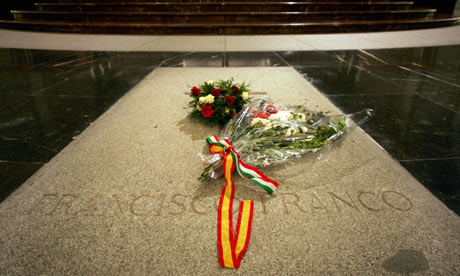
Spain's fascist dicator, Francisco Franco's tomb. The forces of 'El caudillo' killed 113,000 during and after the civil war. Photograph: Philippe Desmazes/AFP/Getty Images
Everything is as grey as granite. The skies, the mountains, the enormous crucifix hewn from the mountain rock – said to be one of the tallest in the world – and, in its shadow, the vast basilica of Valle de los Caídos in the Sierra de Guadarrama, near Madrid, where rests the body of General Francisco Franco, the last dictator of Spain.
Inside is no different. The church is as wide and tall as any cathedral, the distance from entrance to altar long enough to rival St Peter's in Rome. And all of it is filled with the cold, stone grey of the mountains. Above the pews, standing like sentries on their outsized columns, loom hooded statue monks, their granite hands resting on unsheathed swords, as if ready.
At the altar 14 purple-clad Benedictine monks conduct morning mass, a solemn ceremony faithful to the most unchanged Catholic ritual. An altar boy rings a bell and, at that second, the lights are turned off, filling this cavernous place with darkness – save for the beam shining on Christ upon the cross.
There is no denying the sheer, intimidating power of both spectacle and location: the Catholic-raised translator at my side gasps, confessing that he has never seen anything like it.
Spain's socialist government understands the potency of Valle de los Caídos, or Valley of the Fallen. Indeed, much energy has been devoted to taming it. Since 2009, the site has been closed to general visitors; only those attending mass are allowed. Just to make sure, a guard hands arrivals a slip of paper, reminding them that they are there "for religious purposes only".
The result is that, on this sleeting March morning, the priests outnumber the congregation, with no more than 10 people in the pews.
The official explanation is restoration work. But most believe the government wants to ward off those who might be drawn by the two words, etched into the church floor on the far side of the altar, accompanied by a simple cross, Francisco Franco: a burial spot marked on the day I visited by two bouquets, one made up of blood-red roses. Or perhaps by the plaque that honours Franco as the "caudillo de España" (military leader of Spain), who built the Valley of the Fallen in 1959, or by the sight of the Franco crest on the plaza walls outside.
To be safe, on 20 November – the anniversary of the dictator's death in 1975 – visitors' car boots are checked to ensure they are not bringing in placards or flags associated with Franco's fascist Falange party.
The government is considering legislation to deal with the Valle de los Caídos, appointing a panel of historians to advise. Should there, for example, be an exhibition detailing the monument's history, explaining that much of it was built by up to 20,000 prisoners drawn from those Franco had defeated?
The nervousness that surrounds the monument, an hour or so outside Madrid, is proof of the long shadow still cast by the event that defined 20th-century Spain: the civil war that began 75 years ago, when Franco mounted an army rebellion against the democratically elected government of the republic. Officially, the Spanish civil war ended in 1939, but as the acclaimed novelist Javier Cercas puts it when we meet in his Barcelona studio: "This is the past that has not passed. The civil war is still here."
Visit the fashionable La Casa Encendida gallery in Madrid and you can see the evidence. An exhibition by photographer Gervasio Sánchez on "the disappeared" shows bereaved families exhuming the remains of their loved ones from unmarked graves – something that has become a national phenomenon in Spain in the past decade.
In village after village, the children and grandchildren of republicans who were executed and their bodies dumped have sought to find them and give them a decent burial.
Those efforts now have state blessing, thanks to the law on historical memory passed by the Zapatero government in 2007, but they have sparked enormous controversy. Old wounds have been reopened: I was told of one village where a trio of elderly women broke into pro-Franco songs as the bones of long-dead, but still-hated, republicans were lowered into the ground.
Or witness the fate of Spain's best-known judge, Baltasar Garzón, who led the 1998 effort to bring Augusto Pinochet to justice. Having taken on corrupt politicians, international drug-traffickers and terrorists, he finally met his match in the ghosts of Spain's recent past. Last year he was suspended by the country's supreme court after he opened an investigation into the estimated 113,000 people executed by Franco's forces during and after the war.
To be fair, even many republican sympathisers agree that Garzón had overstepped the line, accusing him of folly in pursuing a crime whose chief perpetrator, Franco, is long dead.
But there's no denying the rawness of the nerve he touched. One group agitating in Garzón's defence brands its website Franco no ha muerto - Franco is not dead.
Any attempt to explain the grip the Franco period still exerts starts with the simple matter of chronology. While Germany and Italy were rid of their dictators by 1945, the caudillo ruled 30 years longer. Whatever process of stocktaking their fellow western Europeans undertook was delayed for the Spanish by three decades.
More deeply, Spain differs because while Hitler and Mussolini were utterly defeated, Franco won. "Germans know that they were on the wrong side," says Javier Cercas, whose million-selling 2001 novel, Soldiers of Salamis, grappled with how Spain remembers its civil war – and whose mass success proved how much the question still burns. "There was no blurring. In Spain, there's blurring. On German TV you can't see people saying Hitler was great. You can in Spain," he says, speaking of a Francoist nostalgia that has not been entirely extinguished.
Part of it is generational, with grandchildren eager to look into experiences that were too close for their parents. Part of it is scale. With so much attention devoted to the crimes of Nazism, it's easy to forget the extent of the horrors committed in Spain.
Nigel Townson, a British-born historian based in Madrid, says that the steady flow of revelations from the archives have shocked the Spanish, concluding that, with 50,000 killed even after the civil war had ended, Franco's rule amounts to "the most severe peacetime repression in any country in Europe, barring the Soviet Union".
What all agree on is that Spain's "pact of silence" is now over. The phrase is widely misunderstood, thought to refer to an all-pervasive omerta that barred anyone in Spain speaking of the Franco past after his death, thereby keeping a lid on memories that was only recently blown off. "Bullshit," says Cercas. "Nonsense," says Townson, noting the 3,000 books published in Spanish on the civil war between 1975 and 1995 and the slew of TV documentaries, movies and newspaper articles that accompanied them. The real "pact of silence" was among the political classes, who agreed not to use the past as a weapon against each other during the post-1975 transition from dictatorship to democracy. Central to that pact was the 1977 amnesty law, which has ensured there has not been a single prosecution – not of Franco's men, nor of the republicans accused of massacres of their own (part of the case against Garzón was that he was breaching the 1977 amnesty).
Among the writers and intellectuals who debate such matters, many defend that accord of silence. "We had to make an agreement in order not to fight another civil war," says the historian Jorge Reverte, who cheerfully describes himself as a red as we stand gazing at the iconic image of the 1936-39 conflict, Pablo Picasso's Guernica, which stills draws awestruck crowds at Madrid's Reina Sofía museum.
That political armistice, broken in the last few years, was doubtless necessary. But it has come at a price.
In order to have peace, many in Spain feel they have sacrificed justice. The murderers went unpunished and Franco died in his bed.
What's more, Spain has lacked the catharsis that can come with a full reckoning with the past. There has been no equivalent of Germany's Willy Brandt moment, when the then-chancellor sank to his knees in atonement for the Holocaust.
Could one yet come? Not from the rightwing People's party, which may well form Spain's next government. Several times I was told that too many luminaries of the PP have family ties with the Franco regime: they are the sons and daughters of those who served the caudillo. So far they have been wary of attacking Francoism for fear of seeming to condemn their own forebears.
The church won't do it. Franco was, above all, a nationalist, authoritarian Catholic – and Francoist nostalgia is said to endure in Spain's ultra-traditionalist church.
The obvious candidate is King Juan Carlos I, widely credited with holding the country together in the precarious years of transition and standing firm during the abortive coup attempt of 1981. But he too is hardly able to make the move. For he was Franco's chosen heir, whose coronation helped reassure Franco supporters, allowing them to accept the move to democracy.
The task may fall instead to his son, Felipe. Or maybe, wonders Cercas, the healing can only come when "the great-grandchildren" take over – when every last person who lived through those events is as dead and silent as the Valley of the Fallen.

EconomicsSpain: Austerity: New wave of economic shrinkage

After the collapse of the dictator years back now, the Spanish electorate chose a series of governments that varied markedly from conservative to very Leftist.  The actively Leftist govts spent and spent and taxed insufficiently to pay for all the benefits the general populace, especially special sectors designated for entitlements, were receiving.  The debt soared.  When the system was overburned, the system began to falter.  Bailouts from the EU took place, but the EU, the World Bank, and International Monetary Fund required govt discipline itself along with the gobbling public and special interests:  austerity.  So we sadly to come to the latest round of mass demos, led by the usual and unusual array of Leftist activists.

-- Politicarp, refWrite Frontpage political newspotter, analyst, and columnist


Hurriyet Daily News (Oct31,2012)


Spanish economy sees shrinkage again
MADRID - Agence France-Presse


This weekend’s photo shows Madrid demonstrators taking part in a protest against the government’s austerity reforms and the payment of bank’s debts. AFP photo

Spain’s economy wilted in the third quarter of 2011, official data showed yesterday, as the government imposed a harsh austerity program in the midst of a deep recession.

A slide in domestic demand, battered by a 25-percent jobless rate, overwhelmed a slight improvement in the trade balance, according to preliminary figures from the National Statistics Institute. Gross domestic product dropped by a quarterly rate of 0.3 percent, marginally better than the previous quarter’s 0.4-percent decline, the report showed.

But when compared to output a year ago, the economy slumped 1.6 percent in the third quarter - the sharpest annual decline since the end of 2009 during the previous recession provoked by a 2008 property crash.

The eurozone’s fourth-largest economy is hovering on the edge of a sovereign bailout, after already securing a eurozone rescue loan of up to 100 billion euros ($129 billion) for its banks.

Prime Minister Mariano Rajoy said this week that the government had not made a widely anticipated formal request for eurozone aid because it was “not essential”. Spain’s 10-year bond rates rose above 7.0 percent in mid-summer but borrowing costs tumbled after European Central Bank outlined plans in September to buy an unlimited amount of Spanish bonds to curb rates.

The drop in borrowing costs gave Madrid some breathing space although Spanish 10-year bond yields remain relatively high at 5.65 percent. But Madrid hesitates formally to ask for a eurozone bailout with ECB aid, which would mean submitting to strict economic conditions and international supervision. In the meantime, it is battling to slash its heavy public deficit alone, launching a program to squeeze out 150 billion euros in savings between 2012 and 2014, including 39 billion euros in 2013.

That same austerity program, however, acts like a brake on domestic economic activity.

The Bank of Spain warned recently that the efforts to clean up the budget deficit had a “clear impact” on the mid-year slump.

October/31/2012

PoliticsQatar: Diplomacy: Prime Minister says Syria war is genocide


Ynet News (Oct30,2k12)


Qatar PM: Syria war amounts to genocide

Emirate's premier denounces Assad forces' brutality; slams international community, UN over inability to effectively bring bloodshed to its end
AFP
Published: 10.30.12, 09:30 / Israel News

The Prime Minister of Qatar Hamad bin Jassem al-Thani denounced Tuesday the ongoing civil war in Syria, calling it a "war of extermination."

Al-Thani, who also serves as the emirate's foreign minister, strongly denounced Syrian President Bashar Assad's crackdown on the pro-democracy opposition, saying that the ongoing bloody conflict in Syria amounted to genocide.

Related stories:

The United Nations Human Rights Council (UNHCR) says that more than 35,000 people have been killed since the uprising against Assad's regime began, in March 2011.

"What is happening in Syria is not a civil war but a war of extermination against the Syrian people," the sheik told Al-Jazeera TV.

Qatar's proposal to deploy an Arab peacekeeping force in Syria, brought before the Arab League, was unsuccessful.


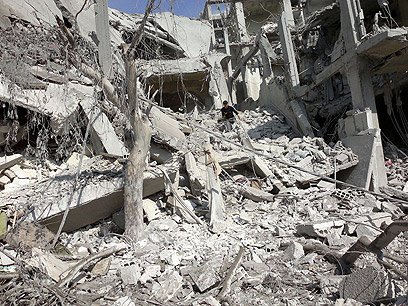
Country in ruins (Photo: AFP)

The UN's peace envoy to Syria, Lakhdar Brahimi, said Monday that despite efforts so far, the situation in Syria is getting worse. The Syrian regime denies that the country is in the midst of acivil war, but according to Brahimi, "If this is not civil war, I do not know what is."

Al-Thani said that the Syrian government had given Assad's forces "a license to kill," adding that the international community's attitude towards the crisis was, was, in effect, a similar license.

He criticized that international community over its lingering inability to effectively bring the bloodshed to its end.

"We have confidence in Mr. Brahimi… but we need to develop a clear idea for a solution before any transfer of power is possible," he said.

Brahimi idea for a ceasefire between the fighting forces for the Muslim holiday of Eid al-Adha was short-lived, as it was violated within 24 hours.

Tuesday, October 30, 2012

PoliticsPhilippines: Moro Muslims win:


Outlook

Aquino-MILF pact a curse on the nation

By 


Rather than a legacy of peace, President Aquino’s pact with the Moro Islamic Liberation Front contained in the “Framework Agreement on the Bangsamoro” will be his curse on the nation. The consequences of the pact, renewed violence in Mindanao and even terrorist attacks in urban centers, will outlive his term, and will be one of the biggest headaches of the next president.
We have to disabuse ourselves of the naive, sappy “give-peace-a-chance” mentality that peace accords always lead to the silencing of guns. From Neville Chamberlain’s 1938 Munich Agreement with Adolf Hitler, to the 1973 Paris Peace Accords that led to the fall of Saigon, to the 1995 Dayton Agreement that ended the Bosnian War but led to the “ethnic cleansing” in Kosovo, ill-conceived peace pacts in the world’s history have often led to greater hostilities. Violence after failed peace pacts intensifies as the parties claim that they were betrayed, infuriating their fighters to fierceness.
The MILF will most definitely be claiming in a year’s time, or even just a few months, that it was betrayed and fooled by the Aquino administration. Why would this happen?
Unless Mr. Aquino becomes a dictator, there is no way he can implement his pact with the MILF. It will be blocked or radically diluted by two institutions: the Supreme Court and Congress.
The Supreme Court will almost certainly be asked to rule on the constitutionality of the Aquino-MILF agreement, as it was with regard to the previous administration’s Memorandum of Agreement on Ancestral Domain.
Either Mr. Aquino didn’t bother to read the Court’s ruling on that case, or he is confident that with his handpicked Lourdes Sereno as Chief Justice, it is now under his thumb that he can just order it to rule as he pleases. But the major reasons why the Court ruled the MOA-AD unconstitutional applies to the Aquino-MILF pact, as constitutional expert Fr. Joaquin Bernas and law professor Harry Roque have explained in their opinion columns. One major reason the Court ruled the MOA-AD unconstitutional is the government’s commitment to amend the Constitution to accommodate the pact, which is beyond the executive branch’s authority to do so.
Mr. Aquino similarly promised that the Constitution will be amended “for the purpose of accommodating and entrenching in the Constitution the agreements of the Parties whenever necessary.” He is deluded if he thinks that the MILF agreed to establish merely an “autonomous region” for the Bangsamoro, the only arrangement allowed under the Constitution. MILF Chair Murad Ebrahim was either so audacious or made a slip of the tongue when he said at the signing ceremony that the pact will allow the MILF  “to rebuild [the Moro] homeland…end occupation and the reign of violence.”
Occupation? The republic’s Armed Forces and the Philippine National Police are occupying, foreign forces? Murad even boasted in his speech that the pact could not have been possible if they had not withstood “the all-out wars in 2000, 2003 and 2008 waged by previous Philippine regimes on the MILF.” The republic wasn’t defending its territory and just waging war?
MILF guerillas now believe that Mr. Aquino agreed to the establishment of an MILF-controlled independent nation-state, even if just a weaker one, in the agreement’s formulation, “in asymmetric relation” to the Philippines. I’ve had sources in the MILF since 1996 when I was the first journalist to visit its main headquarters and interview their chair, Hashim Salamat. “We’ve won, there’ll be a Bangsamoro soon,” they all said.
And even if the Supreme Court rules the agreement constitutional, it will be impossible for that Congress to enact the “Bangsamoro Basic Law” that is absolutely needed to implement the Aquino-MILF pact.
The pact’s fatal flaw in fact is that the entity—Congress—that has the most crucial role in implementing the agreement had absolutely no role in negotiating it. Why would it support it? If Mr. Aquino could not pass the reproductive health bill and even the economically crucial sin tax bill despite his popularity, do you think he could pass a bill—at the closing years of his regime—to create a Bangsamoro nation-state, which will be extremely unpopular and even unacceptable to the majority of Filipinos?
If there is no way for the agreement to be implemented, why did Mr. Aquino enter into it, and made such a big hullabaloo over it? If it isn’t sheer stupidity or hubris, there is only one other reason: as a publicity stunt to prettify his administration, which will soon be held accountable for its incompetence when the economy weakens and as his anticorruption campaign is exposed as a political witch-hunt.
It would be a tragedy, though, for the country that would outlive Mr. Aquino’s term. When the Supreme Court or Congress throws the agreement to the dustbin, the MILF will claim that it was betrayed. It will oil its rifles that after all had not been surrendered to again wage war, with more ferocity this time.
* * *
At the signing of the MILF pact, Mr. Aquino thanked everybody from the Malaysian prime minister to the MILF chair to the Mindanao governors “for making the agreement possible.”  What he did not thank, though, was the AFP [Armed Forces of the Philippines, whose soldiers fought and died defending the republic’s integrity against the Islamic insurgents.
The military brass weren’t even invited to the ceremony attended by over 100 MILF commanders. An Army general in the field lamented: “That omission struck deep in the heart of our soldiers. No credit was given for the AFP’s vital role in creating the conditions for peace talks to proceed. Mr. Aquino praised the efforts of the MILF but not the AFP, as if our soldiers were the aggressors, not the noble defenders of our land. ”
E-mail: tiglao.inquirer@gmail.com

Follow Us


More from this Column: