Wednesday, November 28, 2012

HungaryPolitics: Anti-semite parliamentarian: Wants Jews listed as "threat to national security"

"Marton Gyongyosi, a leading MP of Jobbik, Hungary’s radical rightwing party, called for the list in the Budapest parliament on Monday, saying that it was justified by the increased tensions following the latest conflict between Gaza and Israel."  Besides the crazed logic of this guy's addled brain, it's important to condemn his very idea of a list.  What if such a list fell into the hands of other crazed members of his crazed political party, bloated with hate and venom?  Woud they restrict themselves to vicious talk, or woud they begin vicious actions against this minority community many members of which may not even support Israel in its conflict with Gaza led by Hamas.   How does this fever take hold in a country with a million members of the Hungarian Reformed Church?, which does not countenance such abominations, but seems not to be able to join with other pro-Jews and pro-Israel forces to make such speech out of bounds.  A terribly sad day.

-- Politicarp, refWrite Frontpage politics newspotter, analyst, columnist 


Financial Times (Nov28,2k12)


November 27, 2012 10:26 pm

Hungarian MP calls for Jewish ‘threat’ list


A call by a far-right Hungarian MP for a list to be drawn up of Jewish politicians and government members who pose a “threat to national security” has caused outrage among both Hungary’s estimated 80,000-strong Jewish community and liberal politicians.
Marton Gyongyosi, a leading MP of Jobbik, Hungary’s radical rightwing party, called for the list in the Budapest parliament on Monday, saying that it was justified by the increased tensions following the latest conflict between Gaza and Israel.

More

ON THIS TOPIC

IN EUROPE

“Jobbik MPs have made anti-Semitic and anti-Roma statements in parliament before, but nobody has ever called for a list. This is totally unacceptable in a democracy,” Timea Szabo, an MP for the liberal-green LMP party and deputy chairperson of parliament’s human rights committee, said.
“I am a Holocaust survivor,” Gusztav Zoltai, executive director of the Hungarian Jewish Congregations’ Association, told Reuters. “For people such as me this generates raw fear, even though it is clear that this only serves political ends. This is the shame of Europe, the shame of the world.”
Up to 600,000 Jews from Hungarian territories died in the Holocaust, the majority after mass deportations began in the last year of the war.
Mr Gyongyosi appeared to back track on Tuesday, saying he was referring to citizens with dual Israeli-Hungarian citizenship. “I apologise to my Jewish compatriots for my statements that could be misunderstood,” he said on Jobbik’s website.
Jobbik, which holds 44 of 386 seats in parliament, making it the third-strongest party in Hungary, has been accused of stoking anti-Semitic and anti-Roma feelings and of supporting the Hungarian Garda, a uniformed militia which has made frequent appearances in rural areas with Roma populations, despite being banned by law.
Jobbik denies any anti-Semitic or anti-Roma sentiment, saying that it only wants to protect Hungary from the dangers of international capital and citizens from petty theft and lawlessness.
Liberal and left-wing politicians also accuse Viktor Orbán, the prime minister, and his governing Fidesz party of being soft on Jobbik and pandering to radical policies in order to win voters from the far-right camp.
“Fidesz definitely has double standards. When something happens like this [Gyongyosi statement], they always denounce it but otherwise their actions and policies show otherwise,” Ms Szabo says.
In a short statement on its website, the Hungarian government on Tuesday said it condemned Mr Gyongyosi’s statement “to the greatest possible degree”, adding that it took the “strictest possible action against every form of racism and anti-Semitic behaviour”.

AfricaJuridics/Economics: Land grabs: Threaten world food supply and may extend hunger to millions more

The head of the Food and Agriculture Organization (an affiliate of the UN) is José Graziano da Silva.
He is trying to rally world governments, investors, and farmers' organizations to slow down and control the hyper-active of land-grabbing in the developing world, especially in Africa, after having been in charge himself of the Brazilian solution to the problem.  He has the foresight to see much of where the trends will take the human community and what kinds of food insecurity, hunger and starvation face many millions of dispossesed small farmers.  The land grabbers often sit on their new holdings for years, while the people who once worked the fields are displaced and extremely vulnerable to food shortages and starvation.  I woud add that many of the voluntary aid organizations, including Christian agencies, fit right into the system of denying small farmers land on which to take care of themselves and their neibours long-term.  I think it's key to note that Da Silva believes that in Africa there is plenty of room for investors in large farming operaitons and for small farmers who simply must not be dispossessed; one system can accomodate both kinds of ownership and forms of labour.  The key here is the difference in the kind of crops that do better in mechanized large farming operations, compared to the kind of crops that require hands-on involvement by small farmers.

-- Lawt (juridics) and EconoMix (economics, business and labour) refWrite Frontpage


The Guardian London UK (Nov28,2k12)

Land deals in Africa have led to a wild west – bring on the sheriff, says FAO

Food and Agriculture Organisation chief José Graziano da Silva demands high noon on land grabs that jeopardise food security
MDG : Landgrab and wild west : FAO director Jose Graziano Da Silva
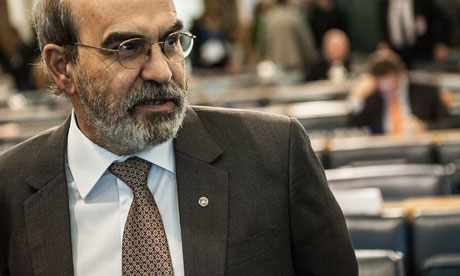
True grit … FAO director general José Graziano da Silva wants major land acquisitions curbed to protect the poor. Photograph: Giorgio Cosulich/Getty Images
Amid warnings that land deals are undermining food security, the head of the UN's Food and Agriculture Organisation (FAO) has compared "land grabs" in Africa to the "wild west", saying a "sheriff" is needed to restore the rule of law.
José Graziano da Silva, the FAO's director general, conceded it was not possible to stop large investors buying land, but said deals in poor countries needed to be brought under control.
"I don't see that it's possible to stop it. They are private investors," said Graziano da Silva in a telephone interview. "We do not have the tools and instruments to stop big companies buying land. Land acquisitions are a reality. We can't wish them away, but we have to find a proper way of limiting them. It appears to be like the wild west and we need a sheriff and law in place."
Large land deals have accelerated since the surge in food prices in 2007-08, prompting companies and sovereign wealth funds to take steps to guarantee food supplies. But, four to five years on, in Africa only 10-15% of land is actually being developed, claimed Graziano da Silva. Some of these investments have involved the loss of jobs, as labour intensive farming is replaced by mechanised farming or some degree of loss of tenure rights.
Oxfam said the global land rush is out of control and urged the World Bank to freeze its investments in large-scale land acquisitions to send a strong signal to global investors to stop.
Graziano da Silva, who was in charge of Brazil's widely praised "zerohunger" programme, expressed his frustration at the slow pace of creating a global governance structure to deal with land grabs, food security and similar problems. In 2008, the UN secretary general, Ban Ki-mooncreated a high-level task force on food security on which Graziano Da Silva serves as vice-chairman.
In May, the committee on world food security (CFS), a UN-led group that includes governments, business and civil society, laid the groundwork for a governance structure for food by endorsing voluntary guidelines on the responsible governance of tenure of land, fisheries and forests.
Tenure has important implications for development, as it is difficult for poor and vulnerable people to overcome hunger and poverty when they have limited and insecure rights to land and other natural resources. But the guidelines took years to negotiate and lack an effective enforcement mechanism because they are voluntary. The CFS is an unwieldy group but has the virtue of inclusivity.
"It took two years to discuss the voluntary guidelines and now we face another two years of negotiations on the principles for responsible agricultural investments," said Graziano da Silva. "We need to speed up the decison-making process without losing the inclusivity model."
The FAO director general said he is doing his best to bring about more co-ordination among the different institutions concerned with food security and suggests the FAO act like an executive arm of the CFS, trying to implement its decisions.
Others share his frustrations. Olivier De Schutter, the UN special rapporteur on the right to food, acknowledges the importance of the CFS voluntary guidelines, but points out the lack of an effective enforcement mechanism. He argues that governments in sub-Sahran Africa or south-east Asia with poor governance, or tainted by corruption, will continue to seek to attract investors at all costs.
"The international community should accept it has a role in monitoring whether the rights of land users, as stipulated in the guidelines, are effectively respected," De Schutter told the Guardian. "Since there is no 'sheriff' at global level to achieve this, at the very least, the home states of investors should exercise due diligence in ensuring that private investors over which they can exercise control fully respect the rights of land users. Export credit agencies, for example, should make their support conditional upon full compliance with the guidelines, and in the future, the rights of investors under investment treaties should be made conditional upon the investors acting in accordance with the guidelines."
For Graziano da Silva, the key is the implementation of the voluntary guidelines at country level; he is encouraged by growing public interest and awareness of the issue. He points to Uruguay as an example of a government prepared to stand up to international land investors – "perhaps the best sheriff" on land deals.
"They have very good laws on land acquisitions," he said, but acknowledged that most countries where land grabbing takes place have little consultation with farmer organisations or have weak or repressive governments.
As for the perennial debate on the respective merits of large- and small-scale farming, the FAO boss said Africa had room for both, adding that Brazil had managed it.
"In some areas of Africa – Mozambique and South Africa – there is scope for large farms, but this approach is only valid for some grains, where the entire cycle is mechanical," he said. "But this is not suitable for fruits, vegetables or many other local products. Cassava has nothing to do with mechanised agriculture and efficiency does not mean big scale. It's the way you combine crops, the use of water you have available. In Africa today, efficiency means better seeds rather than big tractors. The two models have been there forever in agriculture. Sometimes big-scale will provide exports, but local markets are based on small-scale agriculture."

Juridics: Eugene Kontorovich: Law scholar seeks to establish context for the question of settlements besides those of Israel in the West Bank


               This is an important notice of an important study still in progress -- it seeks to contextualize
               the one-sided discussion of Israel's settlements on the West Bank by looking at other
               countries, other settlements.  We look forward to any updates, and eventually the results
               of the completed study.  The discussions and debates around it will also prove quite
               interesting.  Thanks to Eugene Kontorovich and Dana Brusca for launching their
               investigation.

               -- Lawt, refWrite Frontpage juridics newspotter, analyst, columnist


Other Countries’ Settlements

Last month at the Association for the Study of the Middle East and Africa annual conference, I discussed 
a paper I am writing with a former student, Dana Brusca: how one determines whether a violation of 
Art. 49(6)  of the Fourth Geneva Convention has occurred, and what the remedy is. (My talk begins at 
approx. 41:45 min. into the panel.)

Art. 49 focusses on the prohibition of kicking out the inhabitants of occupied territory. Art. 49(6), 
however, provides that “the Occupying Power shall not deport or transfer parts of its own civilian 
population into the territory it occupies.” From the text, it would appear that it requires substantial 
action by the Occupying Power: it does not create a no-go zone for nationals of the occupying power 
who wish to migrate into the occupied territory. “Deport or transfer” is even murkier. It seems to 
require that the occupying power actually move the civilians in for a violation to occur (such things 
have been known to happen).

The ICRC commentaries acknowledge that the provision was adopted “with hesitation” and its 
meaning is not straightforward. This would seem an excellent case for construing a provision in 
light of state practice. Yet discussion of the provision has occurred in a jurisprudential bubble; a 
legal closed circuit.

In the context of Israel, the provision has been read by most international lawyers very broadly 
as requiring the government (assuming it is an occupying power) to actively oppose and prevent 
civilian migration, to not provide services to citizens who have migrated into the occupied 
territory, and so forth. Indeed, in the conventional account, even so-called “illegal” settlements – 
those built expressly in defiance of the Israeli government – violate 49(6). Thus as applied to 
Israel, 49(6) might read, “Nationals of the Occupying Power may not live in the occupied territory.”
When one reads discussions of Israel and 49(6), the only precedents cited are various statements 
about 49(6) – in the context of Israel. One might conclude that Israel has been the only significant 
alleged violator in the post-War period. If there were no other arguable 49(6) cases, then this limitation 
would be natural.

Our project allows for a more dispassionate look at 49(6) by 1) using multiple independent data points; 
2) not focussing on arguably the single most politically controversial situation in the world. Thus to 
be clear, the research project is NOT about Israel.

Indeed, instead of focussing exclusively on Israel [see Parts VI-IX of the ICRC state practice guide], we 
study global state practice. In particular, we examine civilian population movements into occupied 
territory from Morocco, Turkey, Indonesia, and several other cases, and the international legal response 
to these actions.

Our paper is not finished, as we hope to have a comprehensive survey. What we see so far, as described 
in my talk above, is that state practice in regards to these migrations fairly uniformly shows that the 
movement of civilians into occupied territory is not treated as “deportation or transfer” even when it 
is favored or generally supported by the government. Second, even for migrations directly organized 
by the government that may violate 49(6), international authorities have never regarded the removal 
of the “transferred” civilians as the appropriate remedy. On the contrary, U.N.-approved land-for-peace 
deals leave settlers in place, and often even let them vote on a referendum about the occupied area’s 
political future.

One difficulty with making such research comprehensive is that unlike with Israel, where every 
outhouse built by Jews in the West Bank isdocumented and reported, civilian migrations by 
occupying nationals elsewhere is very poorly chronicled, at least in English sources, making it hard 
to determine what the facts, and thus the law is.

I’d be particularly grateful for readers to direct me to information on civilian movement into occupied 
territory, and the government’s attitude towards or role in it in the following contexts (or anything I 
might have missed regarding the colorable occupations discussed above). For the purposes of 
this study, I take a broad view of occupation, and am not interested in the underlying merits of the 
territorial claims.

     1) Jordanian occupation of West Bank, and Egyptian occupation of Gaza.

     2) Vietnamese occupation of Cambodia (which saw the arrival of hundreds of thousands 

of settlers).

     3) Russia’s occupation of Georgian Abkhazia (notable for Russia’s being a member 

of the Middle East Peace Quartet).

      4) Armenia around Nagorno-Karabakh.

Monday, November 26, 2012

Toronto: 2 thrown out: Mayor Rob Ford sacked for conflict of interest, Salvation Army exec David Rennie tossed for alleged $2 million theft

It's a real sad day for those of us who discovered from our local paper, the Toronto Daily Star, that two people holding positions of trust have apparently lost their jobs due to malfeasance.  One is the mayor who was found guilty of conflict of interest, and has had his term terminated prematurely.  The other is the executive director of the Salvation Army's distribution centre in the city who allegedly stole over $2 million in toys and "high end" stuff from Sally Ann.

— Albert Gedraitis with thanks to the Star's journos covering this story.


Toronto Star (Nov27,2k12)

Ford verdict prompts impassioned reaction, 

tough criticism

Published on Monday November 26, 2012


Rachel Mendleson
Staff Reporter 
Upon learning he’d been found guilty of breaking Ontario’s conflict of interest laws and ordered out of office, Toronto Mayor Rob Ford put on a brave face, telling reporters, “You gotta have skin on you like an alligator.”
Ford’s ability to let setbacks — and criticism — roll off his back was put to the test on Monday, as the stunning verdict prompted his detractors to render harsh judgments of their own.
“We need a mayor who knows how to follow the rules,” said Councillor Josh Matlow. “We need a mayor who understands what their role is, what their job description is and how to fulfill it without getting into trouble every other day, no matter who that is and no matter what their political persuasion might be.”
As the decision garnered attention from international media outlets and blogs, including theBBC and Taegan Goddard’s Political Wire, Councillor Glenn De Baeremaeker called it “a sad day for Toronto.”
“Unfortunately the world is looking at us being represented by a mayor who skips out of council meetings to coach football and is being brought before the courts,” he said.

Egypt: Morsi dictatorship: The Egyptian Prez is moving furiously to dam the holes in his take-over policy

Besides acing it in his brokerage of a ceasefire between Israel and Gaza (Iran is said to be busy re-arming Hamas with rockets and missiles), and winning USA Secretary of State Hilary Clinton's praise, then turning around "emboldened" to declare himself virtually a dictator "temporarily," Egypt's President Mohamed Morsi (other spellings in English: Mursi, Morsy) has seized the initiative in his country's politics and now is trying to win conciliations with those who object to his drastic latest move.
Today he has been meeting with members of the country's highest judicial body, which termed his move an "unprecedented attack."  Besides insisting that his decrees were "temporary," the Prez also "stressed its commitment to engaging all political forces in dialogue 'to reach a national consensus on the constitution, which will be the cornerstone of Egyptyian modern institutions.' "

Politicarp, refWrite Frontpage politics newspotter, analyst, and columnist


Ahram, Cairo, Egypt (Nov26,2k12)

Morsi advisor resigns over 'undemocratic' Constitutional Declaration
Samir Morcos, a Coptic Christian presidential advisor, resigns in protest at Morsi's Constitutional Declaration which he says is 'undemocratic and a leap backwards'
Ahram Online, Friday 23 Nov 2012
Share/Bookmark
Views:2177

A presidential advisor has announced his resignation in protest at President Morsi's Constitutional Declaration.  "I have taken the decision to resign because I was not consulted on the latest decision," Samir Morcos, presidential advisor for the democratic transition and state modernisation, told the Al-Ahram Arabic news website on Friday.
President Morsi's surprise announcement on Thursday has incurred widespread criticism
from secular political groups and is the main driver behind Friday's mass protests in Tahrir Square.

The Constitutional Declaration stated the president's decisions cannot be overturned by any
judicial authority. Morsi now has legislative, executive, constitutional and judicial authority, leading commentators and protesters to dub him the "new Pharaoh."

Morcos, one of the three Coptic Christians on the president's 17-person advisory team, said the
declaration was "undemocratic and a leap backwards."

He added that he would announce the details of his resignation once it was accepted and that his
decision was final.

Saturday, November 24, 2012

EgyptRevolution: Counter-Revolutionary Morsi: From President to Dictator

We have to look over the pattern/s in Egyptian President Mohamed Morsi's activities in the last several days to figure out on our own, as much as we can, what Prez Morsi is now up to.  First of all, he didn't need to go to Gaza when it was shelling Israeli communities trying to hide under their Iron Dome, and the Israeli Defence Forces were bombing Gaza City, especially its points of shielding for their hidden strike missles against Israel.  But Morsi went to Gaza.  Why?  He saw his opportunity to become the intervening broker of a temporary peace.  He succeeded, and back in Egypt, US Secretary of State, Hilary Clinton was there to praise him.  So, he brokered a peace rather easily, I woud think.  Let me air my "unfounded" suspicions that the Gazans and Hamas received Prez Morsi's argument for their endorsement and permission to play his own role of Arab Islamacist leadership.  What he offered them was a victory in Egypt itself, but to accomplish that he had to wring an endorsement out of the USA.  This woud position himself to win, as the counter-revolutionary leader of Egypt against that country's authentic revolutionaries (who had been swept aside as the Prez's Muslim Brotherhood took over).  He wanted Hamas's support by joining in the ceasefire (so easily obtained, I repeat).  In exchange, what?  Much — for starters, no destruction of the arms-smuggling tunnels under the Egypt/Gaza border, and no real policing for the near future, as Hamas rebuilds its supply of rockets.  So, winning the war of diplomacy with Hamas in Gaza (and receiving their support in turning out the crowds to acclaim him as Top Dog), he went on to duplicitly "pull the wool over" Hilary's eyes.  She was delighted by the quick settlement that Morsi the Bargaineer exacted so promptly from the Hamas leadership and Gazan masses.  So, Morsi guaranteed the USA funds in the billions for this year alone, and at the same time established his creds.  So he probably confided to Secretarty Clinton that he woud use some of the arts of statecraft he had learned from Egypt's previous dictator, Hosni Mubarak, who was also on the receiving end of USA largesse.

Then, having forwarned Clinto, Morsi went home to Egypt to announce rather promptly that he woud constitute himself as a veritable dictator (like Mubarak) in order to "protect the gains of the revolution." But the authentic revolutionaries, plus the judges who wanted an independent judiciary, refused to go along with his well-planned gambit.  Thus, Prez Mubarak's call of the Brothers into the streets and the public square in Cairo and other cities of Egypt.

— Albert Gedraitis

The Independent London, UK (Nov25,2k12)


Embattled Morsi 

calls out his backers

Both sides of Egypt's political divide take to the streets as judges join protest against President's controversial decree


The Muslim Brotherhood in Egypt has called for a mass demonstration in Cairo this week to show support for the embattled President, Mohamed Morsi, who is facing widespread protests over his controversial decree granting him extensive new powers.

In a statement published on its website, the Brotherhood also called for demonstrations in public squares across the country after early evening prayers today.

The latest blow to Mr Morsi came yesterday when the Supreme Judicial Council, Egypt's highest body of judges, called the move by the President to grant himself near-absolute power an "unprecedented assault" on the judiciary.
Through their statement, the judges joined a growing list of leaders and activists from Egypt's political factions, including some Islamists, who have denounced the decree Mr Morsi says is necessary to "protect the revolution". The council's move reflects the anger within the judiciary.

Mr Morsi has accused pro-Mubarak elements in the judiciary, many of whom were appointed by the former president, of blocking political progress. In the past year, courts have dissolved the lower house of parliament as well as the first panel drafting the constitution, both led by the Muslim Brotherhood.
The council's stand against the President sets the ground for an uneasy alliance between former regime officials and activist groups that helped to topple Mubarak's regime and have in the past derided those officials as "felool", or remnants.

The Presidents' opponents see the judiciary as the only civilian branch of government with a degree of independence, as Mr Morsi holds both executive power and legislative authority.
The judges released their statement following an emergency meeting yesterday. They described Mr Morsi's decree as an "unprecedented assault on the judiciary and its rulings" and called on the President to "distance himself from the declaration and all things that touch judicial authority, its specifications or interference in its members or its rulings."

The primary court and the judges' club in Alexandria announced that they and public prosecutors have suspended all work until the declaration is withdrawn, according to the state news agency, MENA.

Parties opposed to the decree have called for a protest on Tuesday in Cairo, though in a different square from the one where the Brotherhood called on its supporters to gather.