Thursday, January 31, 2013

EconomicsItaly: Banking: Europe's oldest bank cawt hiding huge losses on derivatives

Italy's elections to take place February24-25 have been affected.  But most of all, the Democratic Party led by Pier Luigi Bersani has been shaken as a sure win (by a plurality of votes, of course, no outright majority, this is Italy).  And the present prime minister Mario Monti, leader of a centrist coalition of small parties, is being blamed as much as Bersani.  The Democratic Party, despite disclaimers, is implicated because its local people in Siena, Tuscany, are hand-in-glove with the local powerbrokers who together have run a presitigious 500-year-old bank into the ground, due to a scandal around derivatives deals that went sour.  The bank, Monte dei Paschi, is defawlting to the tune of a billion dollars.  And the scandal is only a week old, still unravelling, and already affecting the local soccer (football) champs, the basketball team, and the twice-a-summer bareback horserace around the civic square.  Everything locally seems to have been subsidized by the bank (nicknamed "Daddy Monte") with what turns out to be illusory budgets.

Poltically, regarding the upcoming national elections, people are wondering how far Silvio Berlusconi can come up from behind and place in the results, alongside Bersani's Democrats and Monti's coalition of centrist small parties.  Were I a betting man, I think I'd place my italianos on devil-may-care Berlusconi.

EconoMix, refWrite Frontpage economics business labour
     newspotter, analyst, columnist


ROME
A scandal engulfing the world’s oldest bank has emerged as a potential game changer in Italy’s national election, threatening to drag down the leading party in the polls and give a critical boost to Silvio Berlusconi’s bid to regain office.
Monte dei Paschi di Siena was founded in 1472, 20 years before Columbus discovered America, but its centuries-old reputation has been severely tarnished by a still-unraveling scandal over derivatives deals worth hundreds of millions of euros and hidden by the bank until brought to light in recent days.
The derivative deals could cost the 540-year-old bank losses of up to 720 million euros ($970 million). What makes it so politically damaging is the banks ties to the center-left Democratic Party.
The bank – located in Siena, a Tuscan city which for decades has been dominated by the Democratic Party– is owned in large part by a "foundation" run by local powerbrokers including Democratic Party officials. As revelations about the bank's obfuscation of its losses have come out, so too have accusations that party representatives in the city – including a succession of mayors and members of the bank’s board – should have had more oversight over Monte dei Paschi’s financial deals.
Polls show the Democratic Party is currently leading the race towards the election of Feb. 24-25 with 34 percent of votes, compared to the 27 percent attributed to Berlusconi’s center-right People of Freedom party.
Critics say the decades-old relationship between the bank and the center-left was far too cozy and led indirectly to the current scandal.
“Many aspects of the scandal remain obscure,” said Tito Boeri, an economist at Bocconi University in Milan, in a front page editorial in La Repubblica newspaper. “But one thing is certain. This affair was born of a system of power created by the intertwining of local politics and banking institutions.”
Pier Luigi Bersani, the leader of the Democratic Party, has insisted that his party bears no responsibility for the banking mess.
But Mario Monti, the technocrat prime minister who is contesting the election as the head of a centrist coalition of small parties, dismissed those assurances and went on the attack.
“The Democratic Party is involved, it has always had a lot of influence on the bank and on Siena’s political life,” he said.
Political interference in the bank’s affairs was “an ugly beast,” he added.

A backlash against Monti?

Monti may be trying to make political capital out of the bank’s woes, which have dominated the front pages of Italy’s newspapers for a week, but the scandal is also affecting his electoral prospects.
While Monti is now criticizing the bank scandal, his government has agreed to come to the aid of the troubled bank with a 3.9 billion euro ($5.3 billion) bailout.
With the rescue now shown to be underwriting the bank's shady deals at a time when the government's tough austerity agenda has led to deep cuts in government spending, many Italians are furious with Monti, whom they see as an out-of-touch, privileged representative of high finance and big business.
The prime minister, who is wealthy in his own right, is a professor of economics and spent many years as a European Commissioner in Brussels.
Beppe Grillo, a former stand-up comedian who leads the maverick, anti-establishment Five Star Movement, which is also contesting next month’s general election, said, "I don't see why we should give almost four billion euros in public money to cover up a bunch of thieves."
When Monti visited a region of central Italy on Sunday that was badly hit by a recent earthquake, he was met by protesters expressing their indignation that he had authorized such a huge sum to the bank when they were still waiting for help with rebuilding their shattered homes. “Money to the bank, yes, to the earthquake survivors, no!” read one large placard.
The buck-passing and exchanging of insults has intensified what is already a febrile political atmosphere.

Monti vs. Bersani

While the Democratic Party is still expected to win the national election, it will probably not have an outright majority, raising the likelihood that it will have to forge an alliance with Monti’s centrists.
But the scandal in Siena has caused so much bad blood between the two political groups that that may be easier said than done, increasing the risk of an unstable, perhaps unworkable, new government.
Meanwhile, Berlusconi has managed to increase his party’s voter support significantly since Christmas and on Monday was exultant about the bounce in the polls.
“Our figures confirm that we have managed a spectacular recovery – in less than a month, an increase of more than 10 percent,” he told an Italian news agency. He promised that recovery would continue over the next month.

Shaken trust

The banking scandal has had a major impact on Siena, an ancient walled city which is invaded by throngs of foreign tourists each summer.
Monte dei Paschi is the city’s biggest employer and has a charitable foundation which between 1995 and 2010 doled out around 2 billion euros to cultural associations, sports clubs, and other worthy causes.
So great was the bank’s largesse that it was known to Siena’s 55,000 inhabitants as “Babbo Monte” or “Daddy Monte.”
With the bank engulfed in the derivatives scandal, many Sienese now fear the end of an era, with much collective belt-tightening ahead.
The bank has already announced that it will have to cut the previously generous grants it gave to Siena’s Serie A soccer team, its basketball squad, and the Palio, the famous horse race held twice each summer in which bareback riders hurtle around the city’s main piazza.


Monday, January 28, 2013

EconomicsPakistan: Garment factory fire: Burns 289 workers to death

Samira Shackle for The Guardian UK has done an excellent job in bringing the dynamite-loaded facts to her readers attentions — not only about the fires abut also about the conditions exploited by the wealthy owners and investors in this seriously anti-normative industrial system, regarding which the Government of Pakistan is supine.  Something more has to be done besides scalding of international garment retailers who only purchase the product of the indigenous Pakistan system.  Responsiblity must be accepted in full by the internal suppliers and the manufacturers, their rich and protected owners and investors, and the Government of Pakistan.  It's an unholy alliance at work there under layers and layers of deceitful Islamic pieties.  These masks must be ripped from the faces of the Pakistani body politics, and a new adequate industrial ethos must take hold in the be-nited land where workers pay everyone's bill as burnt sacrefices.

EconoMix, refWrite Frontpage economics business labour
     newspotter, analyst, columnist


The Guardian, London, England (Jan28,2k13)

Karachi's factory fire exposes Pakistan's lax health and safety regime

Under pressure from wealthy industrialists putting profits over worker safety, labour inspections are on the slide in Pakistan


The death toll from the fire that ripped through a Karachi garment factory this week currently stands at 289, making it the largest number of casualties in a single industrial incident in Pakistan's history. Later, a fire at an illegal shoe factory in Lahore killed 25, bringing the total of Pakistani deaths in industrial incidents that day to more than 300. As the country mourns the enormous loss of life, attention is turning to lax labour laws and the culture of corruption that allows the scant regulations that do exist to be flouted.
The facts of the Karachi fire are nightmarish. After the Karachi blaze started, workers were said to be unable to escape because the doors were locked. It is thought that this was to prevent them from leaving their shifts early, though it has also been speculated that it was because of a recent break-in. Allegedly, there was no emergency exit, with other doors blocked by piles of finished clothes, workers had to smash iron bars on the windows to jump several storeys to escape the flames, and unsafe chemicals in the rickety building made the smoke even more toxic. While the cause of the fire has not been confirmed, it has been blamed on faulty wiring. The owner of the factory looks to have gone into hiding. Although Pakistan's constitution guarantees the right to secure and humane working conditions, these twin tragedies have shown this right is meaningless. Ministers have been queuing up to offer their condolences and condemnation, with President Asif Ali Zardari announcing an investigation, and murder charges being filed against the factory owners for their "utter negligence".
But what exactly is the legal protection for workers in Pakistan? The only legislation on health and safety that exists is the Hazardous Occupation Rule 1963, under the 1934 Factories Act. The act also has a whole section, added in 1997, that is concerned with fire safety. Pakistan is a signatory to the International Labour Organisation's labour inspection convention, which commits the government to ensuring that workers are fully informed about their legal rights, and to enabling inspectors to report on problems that aren't covered by existing regulations.
So laws defending workers' rights do exist. But they are rendered redundant by a total failure of implementation. In fact, an executive order issued under the Punjab Industrial Policy 2003 actually abolished labour inspections, with the aim of "developing an industry and business-friendly environment" to attract fresh investment. The ban originated in Punjab (the province that is home to Lahore), and Sindh (where Karachi is situated), appears to have followed suit. Unsurpisingly, it was implemented under pressure from wealthy industrialists.
Pakistan is a country with an enormous gulf between rich and poor, and an undue amount of influence wielded by a small number of industrial families. The country functions on a deeply entrenched web of patronage and vested interests, meaning that there is little interest in workers' rights and little motivation to change the status quo. Corruption exists at every level, from bribing local officials to overlook an illegal building, to influencing government policy. The civilian regime is weak, and according to labour activists, regulation has deteriorated even further in the past few years along with a general decline in governance.
Textiles are big business in Pakistan, a major export that employs 38% of the manufacturing work force and accounted for 7.4% of GDP in 2011. Pakistani cotton is in high demand in neighbouring India, and underpins Pakistan's growing high-end fashion industry. But garment manufacturers claim that in order to compete with cheap products from Vietnam and India, they are forced to cut corners.
Putting profits over worker safety is a universal problem, and can be seen in sweatshops throughout the developing world, including in neighbouring India and Bangladesh. But the scale of this tragedy has shone a light on the lax oversight and flagrant disregard for human life that runs riot in Pakistan.
Authorities overlooking factory standards, building control, and fire safety have failed at every level. Will this disaster lead to lasting change and an end to the culture of impunity for wealthy businessmen? We must hope that the outraged declarations of politicians are not just empty words to be forgotten once compensation has been paid and the media storm dies down.

DisasterAustralia: Floods: Queensland hit again, Prime Minister Julia Gillard expresses condolences to families of the dead


The Telegraph (Jan28,2k13)

Australia floods: 'We will get through this,' says Queensland Premier

Torrential rain has brought flooding to large areas of Queensland, causing the deaths of three people and forcing thousands more to leave their homes.


Heavy rain, caused by the remnants of a tropical cyclone that hitAustralia last week, flooded several towns in the east of the country over the weekend.
Businesses in Queensland's state capital Brisbane were badly hit, and in the city of Bundaberg 385 kilometres to the north, 1,200 homes were flooded.
Many of Bundaberg's residents have been told that they must leave the area or risk the possibility of death if they stay.
On Monday, Queensland police confirmed that three people had died in flood waters since the weekend.
Prime Minister Julia Gillard sent her condolences to the families of those who died: "Our thoughts are with them and we will be there with practical support as well."
Queensland Premier Campbell Newman said the areas affected by the disaster would get all the help they needed to recover.
"This is a major flood crisis for the people of Queensland however they're up to the challenge. We will get through this," he said.
Source: APTN

Tragedy Brasil: Niteclub owners managers: No safety plan = no business plan adequate to the crowd and entertainment


The outrage is continuing in Brasil, the govt being as much to blame as the owners and musicians.

In the USA, the people who operate this niteclub are totally irresponsible and shoud never be allowed to own or operate any business again in Brasil.  It's time to bring Brasil's entertainment industry — whether niteclubs or "the indusry of faith" (see refWrite page 2 about Brasil's greedy religious entrepreneurs, who are no better than the entertainment owners, managers, bouncers who had those doors locked ... it reminds me of what I've had to study in the fires of the Bangladesh and Pakistan garment industry where the workers were locked into the factory with no way out.  The death tolls are similar.  A pox on such businessmen.

EconoMix, refWrite Frontpage economics business labour
     newspotter, analyst, columnist


ABC News (Jan28,2k13)

Brazil Nightclub Fire: Police Arrest 3 in Santa Maria


By ANTHONY CASTELLANO and  (@kdolak)
See the brief ABC video newscast on refWrite Backpage today


Brazilian authorities have arrested three people in connection to the fire that killed more than 230 people and injured hundreds at a nightclub in Santa Maria, Brazil, this weekend.
The owner of the popular Kiss nightclub, a member of the band Gurizada Fandangueira and the club's security chief have been arrested and are being questioned by police, the BBC reported today.
A fourth person, who the BBC reports is a co-owner of the club, is still being sought by police.
None of the names of those arrested and being sought have been released.
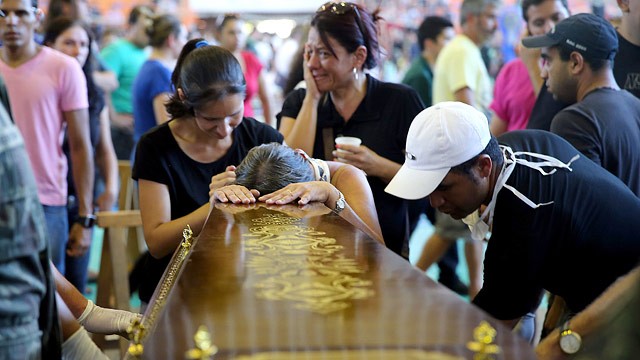
Coffins lined a gymnasium in Santa Maria today as family members tried to identify their loved ones after a fast-moving fire tore through acrowded nightclub Sunday morning.
A community gym near the Kiss nightclub has been converted to a temporary morgue were family members were led in one by one Sunday night and early this morning to identify the dead. Outside the gym police held up personal objects, including a black purse and blue high-heeled shoe, as people seeking information on loved ones crowded around, hoping not to recognize anything they were being shown.
"Doctors from other parts of Brazil were flown in to assist the medical side of this," BBC reporter Julia Carneiro told ABC News this morning. "One hundred people are injured and in hospital. Some have been flown to other cities that have better hospital capacity."
Flames and smoke outraced a terrified crowd at the Kiss nightclub, located in the southern city of Santa Maria, shortly after 2 a.m. Sunday morning. Panicked partygoers tried to outrun flames and black, thick smoke, but the club appeared to have only one open exit, police Maj. Cleberson Braida Bastianello told The Associated Press.
PHOTO: Relatives of victims from a fire that broke out at a nightclub weep, during their funeral in Santa Maria, 550 Km from Porto Alegre, southern Brazil on Jan. 27, 2013.
JEFFERSON BERNARDES/AFP/Getty Images
Relatives of victims from a fire that broke... View Full Size
Deadly Inferno Inside NightclubWatch Video
Brazil Nightclub Fire: Nearly 200 People Killed Watch Video
Police confirmed that the toll had risen to 231 with the death of a hospitalized victim.
Hours after the fire, cellphones on the victims were ringing inside the still-smoldering nightclub as family members tried to contact their loved ones, Brazilian radio reporter Sara Bodowsky told "World News" anchor David Muir.
"It's really like a war zone in here. We have [over 230] bodies laid down, side by side, so the families go inside one by one. They look at the bodies," Bodowsky said.
The first funerals for the victims were scheduled to begin later today for those families who have identified their loved ones.
"It was terrible inside. It was like one of those films of the Holocaust, bodies piled atop one another," police inspector Sandro Meinerz said Sunday. "We had to use trucks to remove them. It took about six hours to take the bodies away."
Investigators believe the blaze began when a band's small pyrotechnics show ignited foam sound insulating material on the ceiling, releasing a putrid haze that caused scores of people to choke to death.
Survivors and police inspector Marcelo Arigony said security guards briefly tried to block people from exiting the club in the mass confusion and chaos moments after the fire began.
But Arigony said the guards didn't appear to block fleeing patrons for long.
"It was chaotic and it doesn't seem to have been done in bad faith because several security guards also died," he told the AP.
Police Maj. Bastianello told the AP by telephone the death toll was likely made worse because the nightclub appeared to have just one exit through which patrons could exit.
A security guard told the newspaper Diaro de Santa Maria that the club was filled to capacity, with 1,000 to 2,000 people inside.
Meanwhile, people outside tried to break through walls to get in to save those trapped inside.
Michele Pereira told the Folha de S. Paulo newspaper that she was near the stage when members of the band lit some sort of flare.
"The band that was onstage began to use flares and, suddenly, they stopped the show and pointed them upward," she said. "At that point, the ceiling caught fire. It was really weak, but in a matter of seconds it spread."
Guitarist Rodrigo Martins told Radio Gaucha that his band, Gurizada Fandangueira, started playing at 2:15 a.m. "and we had played around five songs when I looked up and noticed the roof was burning."
"It might have happened because of the Sputnik, the machine we use to create a luminous effect with sparks. It's harmless, we never had any trouble with it," he said. "When the fire started, a guard passed us a fire extinguisher, the singer tried to use it but it wasn't working."
He confirmed that accordion player Danilo Jacques, 28, died, while the five other members made it out safely.
Brazilian President Dilma Rousseff, who was attending a summit with European Union leaders and the Community of Latin American and Caribbean States in Chile, cut her trip short and returned home to Brazil Sunday.

FloodsIndonesia: Jakarta: Clogged drains of sinking city leave thousands homeless

Jakarta is recovering from the latest floods due to monsoon rains, against which the city no longer protects its citizens and the infrastructure deteriorates and the city is left to sink, to become a giant sinkhole.  Shame!

— EconoMix, refWrite Frontpage economics business labour
     newspotter, analyst, columnist


The Weather Channel (Jan28,2k13)
Downtown Jakarta, Indonesia has flood problems for 2 weeks, with 2 more months of monsoon rains yet to go ... here people wade thru a flooded street to reach their offices on Jan18.  More than 20,000 people were living as evacuees on Jan22, while 20 people were killed during the widespread natural disaster, as the skinking of the city becomes worse year by year.  ADEK/Berry/AFP/Getty


Northern Life: Lake Klaipedia, Lithuania: Ice-fishing


Great sport and a civic event, thousands of ice fishers seek the lake's large stock of smelt during the times when the freeze-over brings much else to a halt in this lakeside city in middle Lithuania.

Lith, refWrite Frontpage special correspondent for Northern Life


Ice fishing on Lake Klaipedia, Lithuania (Jan28,2k13)


PoliticsRussia: Putin & Lavrov: The inner logic of Russia's foreign policy and advice to the USA


Russia's 3rd-term President Vladimir Putin (who has been sick in recent months) and his feisty foreign affairs minister, Sergei Lavrov, have given an explanation of Russian foreign policy, as recounted by Fred Weir in SCM, that has changed my own thinking in regard to the geostrategics of the situation, seeing the world thru Russia's eyes.  It holds not only for the Russian Federation as such, but also for imitative autonomous republics in Central Asia -- like Kazakhstan, Kyrgyzstan, Uzbekistan, Tajikistan, Turkmenistan, and in Caucusus the historically Christian states of Georgia and Armenian, and the Muslim-majority Azerbaijan -- most with overwhelmingly Muslim populations and all repressive of religious pluralism and saddled with state-guided religions-minded policies based on fear to the point where they feel they must outlaw the writings of one of Islam's most creative theologians of recent times, Said Nursi, because his understanding of Islam might bring it to life however gradually in ways that threaten these latter régimes, were they granted any religious freedom at all.  But this anti-pluralism approach also threatens the kind of Islam that exists in its tight structures and is fully tolerated within the Russian Federation itself and is heavily regulated, the official Islam.  It's the same geostrategic understanding that prevails with Putin and Lavrov (but not so much Prime Minister Dimitry Medvedev who woud like to be closer to the leading Western approaches).  I finally realized that what the Russians had learned in Chechnya with its Muslim majority and bitter jihadist war, and even before that in its effort to maintain its conquest of Afghanistan, was only part of the picture.  The Russian leaders understand that the Muslim masses of Russia are a tinderbox that, with free propaganda and "visitation rights," coud bring the Sunni constellation into a raging vortex of jihadism, presumably one Assad is beheaded.  That's behind the current effort to explain to France (in Mali and Africa generally) and to the USA which did not win the hearts and minds of the Syrian opposition to align itself conclusively with the West.  Indeed, from Putin's and Lavrov's perspective, the Western intransigence in trying to leverage diplomatically the ouster of Bashar al-Assad where the opposition won't even talk to the present regime, is in the same zone of disaster where it allowed Hosni Mubarak to be leveraged out of office in Egypt, and Ghaddafi out of Libya, and perhaps Tunisia as well.  Putin and Lavrov are saying: work with the dictators who can keep a lid on these countries  by repression.  And don't "foment jihadist 'blowback' " which, when it spreads, will make the whole world much more volatile than at present.  Putin and Lavrov don't want the Arab Spring to become the Central Asian Spring, nor especially the Russian Muslim Spring.  That woud magnify the amplitude of jihad over their national thresholds by a factor of 100.

They are trying in good faith to prevent the USA's "naive" policy of democratizaton of the world from setting everything in the world into a bloody motion that can only lead to more terror, more torture, more decapitations, more hand-cuttings-off ...  We are reaching a critical hour.  I'm hoping much, nevertheless, for the revolution in Syria to fill its course and establish a new régime that seeks justice for all in its territory.  I hope that Christians and their ancient communities in Syria will be ready and able to make peace with the Sunni majority, and that the terms will not be severe or humilitating.

-- Politicarp, refWrite Frontpage politics newspotter, analyst, columnist


Christian Science Monitor (Jan28,2k130

Russia's Vladimir Putin says West is fomenting jihadi 'blowback'

Moscow is criticized for weak support of the Arab Spring, and for actively backing Bashir al-Assad in Syria. But the Kremlin says its policies are consistent and the West is exporting revolt.

by Correspondent / January 25, 2013


MOSCOW
Both Vladimir Putin and his foreign minister have lashed out at the West in recent days for pursuing what they regard as naive and incoherent Middle East policies.
The critique targets Western backing of anti-dictator rebellions in Libya and Syria, which, as Mr. Putin tells it, only fuels the spreading flames of extreme Islamist insurrection, including the current war in Mali and last week's terrorist strike on a gas complex in Algeria.
"The Syrian conflict has been raging for almost two years now. Upheaval in Libya, accompanied by the uncontrolled spread of weapons, contributed to the deterioration of the situation in Mali," Mr. Putin said at a meeting with new ambassadors in the KremlinThursday.
"The tragic consequences of these events led to a terrorist attack in Algeria which took the lives of civilians, including foreigners," he added.
 "Those whom the French and Africans are fighting now in Mali are the same people who . . .  our Western partners armed so that they would overthrow the Gaddafi regime," in Libya in 2011, Russian Foreign Minister Sergei Lavrov told a news conference Wednesday.
Many in the West may be inclined to shrug off Russian criticism as the routine sniping of a government whose Mideast influence has slumped since the Arab Spring began, or the self-serving rationale of an autocratic regime that fears popular revolution and automatically backs authoritarian rulers.
 But many Russian experts, including sharp critics of the Kremlin on other issues, argue that Russian leaders are being realists about the blowback that has followed Western interventions in the Muslim world.
They say Moscow has been dealing with the threat of militant jihadists since the Soviet Union's disastrous 1980s war in Afghanistan, and has watched as it has shown up in parts of Russia's heartland. Kremlin leaders accuse the West of an enthusiasm for toppling dictators that has led, not to democracy, but to spreading mayhem and rising Islamist militancy across West Asia andNorth Africa.
2
"Russia is on the frontier, we are in jihad territory," says Yevgeny Satanovsky, president of the independent Institute of Middle Eastern Studies in Moscow.
"Our own fringes, the northern Caucasus,Central Asiaand even the central Volga region  are threatened. That's why we're very clear about who the enemy is.. . .  We know this, and you would think that after 9/11 and other events that our American and European colleagues would have some clarity about it, too. Yet they always seem ready to play with fire, and to use militant jihadists against Russia and its national interests – as they did in Afghanistan, Chechnya, Libya, and Syria," he adds.
Over the past decade Russia has used its UN Security Council vote to oppose the US invasion of Iraq aimed at overthrowing dictator Saddam Hussein; yet it has strongly supported NATO's anti-Taliban mission in Afghanistan. Last year, Putin even urged the Western allies not to leave Afghanistan before the "job was done" and Moscow gave NATO the use of a huge airbase in central Russia to help with the resupply effort to its embattled forces there. 
Moscow abstained on the March 2011 Security Council resolution that authorized the use of force "to protect civilians" in Libya, and last month it actually backed another resolution empowering France and others to intervene against Islamists threatening to overrun Mali.
On the other hand, Russia has repeatedly vetoed any resolution aimed at international cooperation to ease Syrian strongman Bashar al-Assad from power and continues to back his regime with political support and shipments of weaponry. The UN estimates 60,000 killed in the ongoing civil war in Syria, with some 500,000 to 600,000 displaced or categorized as refugees.
3
Outsiders may be forgiven for seeing Moscow's policies as a bit tangled, not to say hypocritical, but many Russian analysts argue that they have been completely consistent – with the sole exception of former President Dmitry Medvedev's decision to abstain on the Libya "use of force" resolution, which was publicly slammed by then-Prime Minister Putin.

"The Libya resolution contained promises to Russia that were never delivered. Today our abstention on that vote can be clearly seen as a mistake, a symption of Medvedev's non-professionalism," says Mr. Satanovsky.
The Russians argue that they back secular goverments and stability, even where it is enforced by a dictatorship, because the alternatives are almost universally worse. They insist that Western efforts to back democratic revolution have backfired almost everywhere, and will continue to do so.
"All attempts to export revolution end badly," says Andrei Klimov, deputy chair of the State Duma's international affairs committee.
"In Iraq, the Americans came in to eliminate fictitious weapons of mass destruction, and knocked out all the pillars of stability in that country. Look at the mess it's in today.... Libya was stable, Syria was stable, until revolutions aided and abetted by Western powers tore them apart. All this chaos is a gift to militant fundamentalists and no one else," he adds.
Russia's backing for the current French-led intervention in Mali is just a case of lining up against the common enemy, the jihadists, pro-Kremlin analysts say.
They point out that the government the West is propping up in Mali is a dictatorship, the result of a military coup last year that overthrew the democratic government on the eve of elections.
"We agree with the French about this. Maybe they're finally seeing the light," says Sergei Markov, vice president of the Plekhanov Economic University in Moscow and a frequent adviser to President Putin in the past.
  "It's an attempt to stem the damage that's a result of the misguided operation in Libya. It's against the jihadists and we support it," he adds.
"When the West is helping to destroy a stable regime, and willfully opening the gates to the radical Islamists, we oppose it. . .   We wish that Russia and the West could work together on this. We are willing, but we doubt the West is ready to cooperate with us," Mr. Markov says.
"Will it have to take a few more Western ambassadors being killed by the very forces they created before they will listen to us?"